Google GMail dominating the email market

Google's GMail was launched in April 2004 and only in February 2007 Google dropped its invite system to open up to the general public acc. to Wikipedia's history of GMail. That's some five years of operations up to now.
It kind of amazed me how many people I know have GMail as their primary mail provider. So I took the chance today to get a bit of statistics to check my gut feelings:
A friend of mine selected some (mostly American) bloggers that have indicated specific interests in a topic related to his Doctoral thesis. This sample ended up to be 1,375 people. These folks have 295 different email domains. Only.
A whooping 46% of the (rather random) sample use GMail, 12% Yahoo, 8% Hotmail and about 3% AOL. While Yahoo has some foreign domains in the sample (yahoo.co.uk, yahoo.ca, see mostly American bloggers above), these add up to around 0.1% of the sample so it's not really significant.
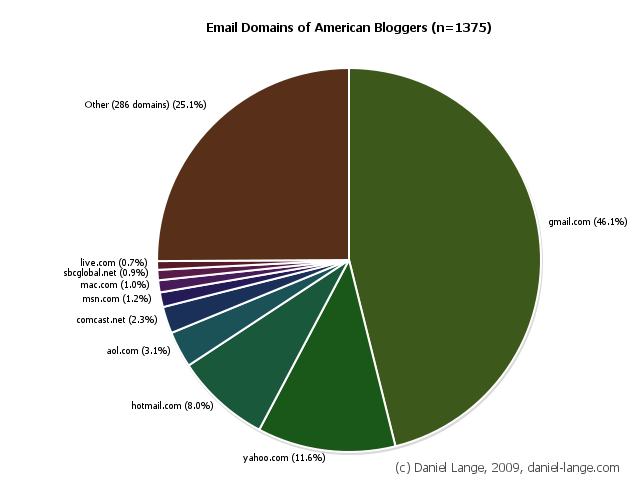
This data is in no way representative, but still wow. Google basically has a monopoly on search and now seems to have a close-to-majority footprint in personal email.
I guess the dominance is currently larger in the States than in Europe or Asia as GMail has only gradually learned languages beyond English.
Large local providers should also have some foothold in these markets. Similar to the Comcast and SBC customers still significant in sample depicted above. Just the local providers in Europe and Asia will be somewhat stronger (for now). Google is also aggressively targeting corporations with hosted email and apps now so one can expect further and accelerated growth in that area. Quite a number of companies are considering using hosted email instead of the conventional mail system they have operated on site for many years now.
So while Gina Trapani recommends "Break Google's Monopoly on Your Data: Switch to Yahoo Search", may I humbly point out: It's becoming quite impossible to just keep your emails between the recipient and the addressee these days.
Even if you personally do not use GMail, Google can (technically) still profile you because a huge chunk of people you communicate with send from GMail and receive and store your emails there.
Nearly all email that is sent also passes spam filters before delivery. Google bought the Postini spam filter in 2007. That anti-spam service is used by many enterprises and even city governments, see here.
So time to consider (unencrypted) email as what it has always been: The digital equivalent of a postcard.
Just now Google has become the postmen. All of them, every second shift. You should hope they're not nosey. Or send letters.
Update:
11.05.2014: Benjamin Mako Hill has written a blog entry Google Has Most of My Email Because It Has All of Yours doing analysis for his own email box. He found a third of his inbox emails come from Google and - as he doesn't usually reply to newsletters and the like - more than half of his own email replies (57% in 2013) end up at GMail. He published his code in case you want to do the analysis on our own email.


 .
.